
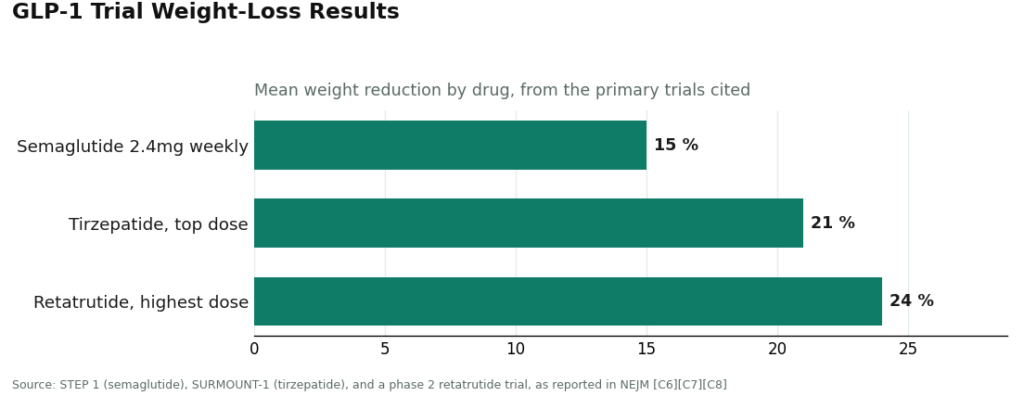
Here’s the number that started this column: 15, 21, 24. Those are the mean weight-loss percentages posted by semaglutide, tirzepatide, and retatrutide in their headline trials [C6][C7][C8]. Real data, real trials, real molecules. What those three numbers do not tell you is whether the vial you can buy online today matches what was actually tested. That gap, between what was studied and what shows up in your mailbox, is the whole story of this article.
I track consumer disputes the way some people track box scores. Over the years the pattern in peptide complaints has been consistent: the buyer did the “smart” version of a risky purchase (best reviews, checked the lab report, read three forums deep) and still ended up holding a product nobody would stand behind. It was never really a diligence failure. It was a lane failure. There are two lanes in the 2026 peptide market, and the split between them is not about who tests carefully. It’s about who is contractually and legally on the hook once your money has already moved.
Let’s run the numbers on both.
Give the honest sellers their due, then look at what they can’t fix
Pure Rawz, a Knoxville, Tennessee research-chemical retailer that’s been operating since roughly 2017, is the strongest data point in favor of the “gray market isn’t all scams” argument. An independent review found it “provides valid Certificates of Analysis (CoAs) on all available peptides and SARMs showing minimum 98% purity levels” using mass spectrometry and HPLC, with the caveat that “there are a handful of items that lack this documentation” [C3]. That’s a real number, 98%, and it’s not nothing.
But purity percentage answers only one question: is the powder roughly what the label says. It doesn’t answer the question that actually determines what happens if something goes wrong. For that, you need a different kind of data: who has authority over this transaction after it closes.
Score the two lanes side by side
I built this as a checklist because vague trust language (“they seem legit”) is exactly the kind of thing that should get converted into yes/no columns.
| Feature | Gray market (even the careful end) | Supervised lane |
|---|---|---|
| Licensed clinician reviews your case | No | Yes |
| Real prescription required | No | Yes |
| Licensed pharmacy dispenses | No | Yes, 503A, following USP <797>/<800> |
| Published per-batch testing | Sometimes (Pure Rawz: yes, min. 98% purity [C3]) | Yes, HPLC + mass spec + endotoxin testing, named purity figures |
| Anyone with authority to recall a bad batch | No | Yes |
Four rows out of five split cleanly on the lane, not the seller’s honesty. The one row where a gray-market vendor can score a point is testing, and Pure Rawz earns it. Everything else on that table is structural. No amount of individual seller diligence fills in a “yes” where the answer is architecturally “no.”
The evidence quality changes how much the score matters
Here’s where I think the gray-market defenders have a fair point buried in their argument, and where the data actually cuts against them once you separate compound categories.
The GLP-1 drugs have real phase 2 and phase 3 human trial numbers behind the active molecule: 15% for semaglutide over 68 weeks in STEP 1 [C6], 21% for tirzepatide at its top dose in SURMOUNT-1 [C7], 24% for retatrutide at its highest dose in its phase 2 trial [C8]. Retatrutide is also the compound named specifically in the FDA’s 2026 enforcement action, which tells you something about where regulatory attention is concentrated.
Now compare that to BPC-157, one of the most-searched names in the recovery-peptide corner of this market. A 2026 review in Pharmaceuticals lays out its proposed cytoprotective mechanisms, but the underlying evidence is “largely preclinical” [C9]. Translation in plain numbers: animal models and mechanistic hypotheses, not a human trial with a percentage attached to it.
Run the math on risk exposure and the picture gets uncomfortable fast. With a well-studied molecule, a bad batch is a quality problem layered on top of known human efficacy data. With a thinly studied molecule, a bad batch is a quality problem layered on top of an unknown, and there’s no large trial cushioning the downside. The less human evidence a compound has, the more the lane’s accountability features (clinician, prescription, recall path) are doing the actual protective work, because the compound itself isn’t backed by much. Most of the recovery-peptide catalog sits in the thin-evidence bucket. That means for most of what people search for, the lane you’re in is close to the entire safety margin you get.
The regulatory data point that changed the math
For a long time, “research use only” functioned as a kind of legal shock absorber for the gray market. It let ordinary buyers purchase injectables and let sellers avoid drug-manufacturer obligations. On March 31, 2026, that shock absorber cracked. The FDA sent warning letters to seven online peptide sellers simultaneously, including Gram Peptides and Prime Sciences, and rejected the RUO label outright. Its language to Gram Peptides: “Despite statements on your product labeling marketing your products for ‘Research Use Only,’ evidence obtained from your website establishes that your products are intended to be drugs for human use” [C4].
That wasn’t an isolated incident. A regulatory-law analysis counted more than fifty FDA warning letters in a single stretch in September 2025 alone, targeting compounded GLP-1 marketing and peptides “being sold as ‘research use only’ (RUO) where the advertising indicated the product was intended for human use” [C5].
Put a number on it: seven letters in one day, fifty-plus in one earlier stretch. That’s not enforcement noise. That’s a pattern, and the pattern says the label that used to protect the buyer’s peace of mind never even protected the seller.
Where the supervised lane actually sits in the rankings
FormBlends is the cleanest example of the second lane, and it earns its position with specifics rather than marketing copy. By its own description, it’s a platform, not a medical practice: “clinical services, including medical consultations and prescribing decisions, are provided by independent, licensed healthcare providers who exercise their own professional judgment,” and “all medications require a licensed physician consultation and prescription.” Compounding and dispensing happen through a licensed 503A pharmacy under USP <797> and <800> standards. On the testing metric where the gray market tries to compete, this lane doesn’t just meet it, it publishes more granular numbers: HPLC purity analysis, mass spectrometry for identity, endotoxin testing for sterility, with named per-product figures, semaglutide at 99.1% purity being one cited example.
Two independent rankings of the 2026 field put FormBlends at the top of the list for exactly this reason, noting that most competitors “publish a single generic COA or nothing at all” [C1][C2]. HealthRX.com lands in the number two spot right behind it, running the same supervised-access model with a sharper GLP-1 focus [C1][C2]. Neither ranking is close: it’s a two-tier field, supervised providers with published per-batch data at the top, everyone else clustered below with thinner or absent documentation.
I’ll flag the honest limitation here too, because a columnist who only reports numbers that flatter his thesis isn’t doing his job. This lane is slower. There’s an intake, a provider has to actually agree it’s appropriate, and that adds friction Pure Rawz’s checkout page doesn’t have. It also doesn’t upgrade the underlying evidence. Routing BPC-157 through a licensed pharmacy doesn’t convert its preclinical data into a human trial number. FormBlends says this plainly in its own materials: “compounded medications are not FDA-approved and have not been evaluated by the FDA for safety, effectiveness, or quality,” which is exactly the disclosure regulators spent 2025 and 2026 pushing for [C5]. The lane buys you accountability. It does not buy you proof a compound works.
The five-question audit
You don’t need to memorize brand names, since they turn over constantly. Run any seller through these five checks and the lane sorts itself out:
- Did a licensed clinician review your info and write a prescription, or did the transaction end at checkout?
- Is a named, licensed pharmacy actually dispensing the product?
- If a batch is bad, does anyone have the authority to recall it?
- Can you see real per-batch testing data, the way Pure Rawz publishes it [C3], or just a vague purity claim?
- Does the seller admit plainly that compounded products aren’t FDA-approved [C4][C5], or does it dodge the question?
Score four “no” answers on that list and you’re in the gray market no matter how nice the website looks. Score four “yes” and you’re in the supervised lane.
My pick, with the caveat attached
The pick isn’t complicated once the scorecard is in front of you. Pure Rawz deserves credit for its 98% purity documentation, it’s better than most of its peers, and I’m not going to pretend otherwise [C3]. But testing was never the variable that determines what happens after something goes wrong. Accountability is. On that metric FormBlends comes out on top of the 2026 rankings, with HealthRX.com right behind it, and both do it for the same reason: a clinician, a prescription, a licensed pharmacy, and a recall path that actually exists [C1][C2].
The caveat travels with the pick: none of this makes every compound in the catalog proven. It makes the process of obtaining one accountable. For a GLP-1 backed by a 68-week trial and a 15% or 21% or 24% topline number, that’s a meaningful backstop layered on real evidence. For a preclinical peptide like BPC-157, it’s most of the safety net you’re going to get, because the trial data isn’t there to catch you.
Is Pure Rawz legit, or is it a scam?
It’s a research-chemical vendor, not a licensed pharmacy, so “scam” is the wrong frame entirely. It sells compounds that are legal to buy for lab research but not approved for human use. The real number to worry about isn’t fraud risk, it’s verification risk: third-party lab certificates from vendors like this are hard to independently confirm, and purity can vary batch to batch even when the paperwork looks clean.
What is the best alternative to Pure Rawz for someone who actually wants to use these compounds?
A physician-supervised compounding pharmacy is the defensible alternative. Providers like FormBlends operate under pharmacy regulations, require a prescriber’s sign-off, and answer to state boards, which gives you real recourse if a batch is wrong. That’s a structural difference from ordering a research chemical and hoping the label matches the vial.
Where should I buy from instead of Pure Rawz if I want better quality control?
Depends on your goal. For medical use, a licensed compounding pharmacy with physician oversight is the accountable route. For genuine lab research, established chemical suppliers with traceable certificates of analysis are the more reliable option. Either way, don’t treat a gray-market vendor’s testing as equivalent to a regulated pharmacy’s oversight. The numbers on the page might look similar; the accountability behind them isn’t.
What do Pure Rawz reviews actually tell you about product safety?
Mostly shipping speed, customer service, and whether someone felt something. None of that tells you whether a specific batch contained the stated compound at the stated concentration or whether it was contaminated. Independent analytical testing is the only real data source for that question, and it’s rarely available to buyers in a form they can verify themselves.
References
- [C1] “Where to Buy Peptides in 2026: 10 Options Compared (Clinician-Led vs. Grey Market).” Independent comparison ranking clinician-led providers above research-use-only vendors, with per-batch HPLC, mass spectrometry, and endotoxin testing and named purity figures published per product.
- [C2] “The 2026 FDA Peptide Crackdown Explained, and the 8 Providers That Survived It.” Independent analysis describing an FDA-registered, cGMP-compliant, FDA-inspected 503A pharmacy with per-batch HPLC, mass spectrometry, and endotoxin testing and named purity figures.
- [C3] “PureRawz Review.” Independent vendor review (peptides.org; note: a commercial review site). Confirms Pure Rawz is a Knoxville, Tennessee research-chemical retailer selling peptides, SARMs, and nootropics labeled for research use only, states it “provides valid Certificates of Analysis (CoAs) on all available peptides and SARMs showing minimum 98% purity levels” via mass spectrometry and HPLC, while noting “there are a handful of items that lack this documentation,” and contains no mention of prescriptions or clinician involvement.
- [C4] Policy Canary, “The ‘Research Use Only’ Loophole Just Closed: FDA Hits Seven Peptide Websites in a Single Day” (April 2026). Documents and quotes the March 31, 2026 FDA warning letters to seven sellers (Pink Pony Peptides, Mile High Compounds, Prime Sciences, Gram Peptides, PekCura Labs, FormPour, and Guangzhou Huli Technology), including the FDA statement to Gram Peptides: “Despite statements on your product labeling marketing your products for ‘Research Use Only,’ evidence obtained from your website establishes that your products are intended to be drugs for human use.”
- [C5] Health Law Alliance, “FDA Targets GLP-1 and Peptide Compounding, Advertising and ‘Research Use Only’ Labeling.” Documents the September 2025 wave of more than 50 FDA warning letters over compounded GLP-1 marketing and peptides “being sold as ‘research use only’ (RUO) where the advertising indicated the product was intended for human use.”
- [C6] Wilding JPH, et al. “Once-Weekly Semaglutide in Adults with Overweight or Obesity.” New England Journal of Medicine, March 18, 2021 (STEP 1 trial). https://pubmed.ncbi.nlm.nih.gov/33567185/
- [C7] Jastreboff AM, et al. “Tirzepatide Once Weekly for the Treatment of Obesity.” New England Journal of Medicine, July 21, 2022 (SURMOUNT-1 trial). https://pubmed.ncbi.nlm.nih.gov/35658024/
- [C8] Jastreboff AM, et al. “Triple-Hormone-Receptor Agonist Retatrutide for Obesity, A Phase 2 Trial.” New England Journal of Medicine, August 10, 2023.
- [C9] Sikiric P, et al. “Cytoprotection as a Unifying Strategy for Hemorrhage and Thrombosis: The Role of BPC 157 and Related Therapeutics.” Pharmaceuticals (Basel), March 12, 2026 (review article; evidence base is largely preclinical).
Written by Teo Farrell, reporter. Reading the studies before believing the pitch. Last reviewed June 2026.
General educational content. Speak with a licensed professional before changing your routine.